

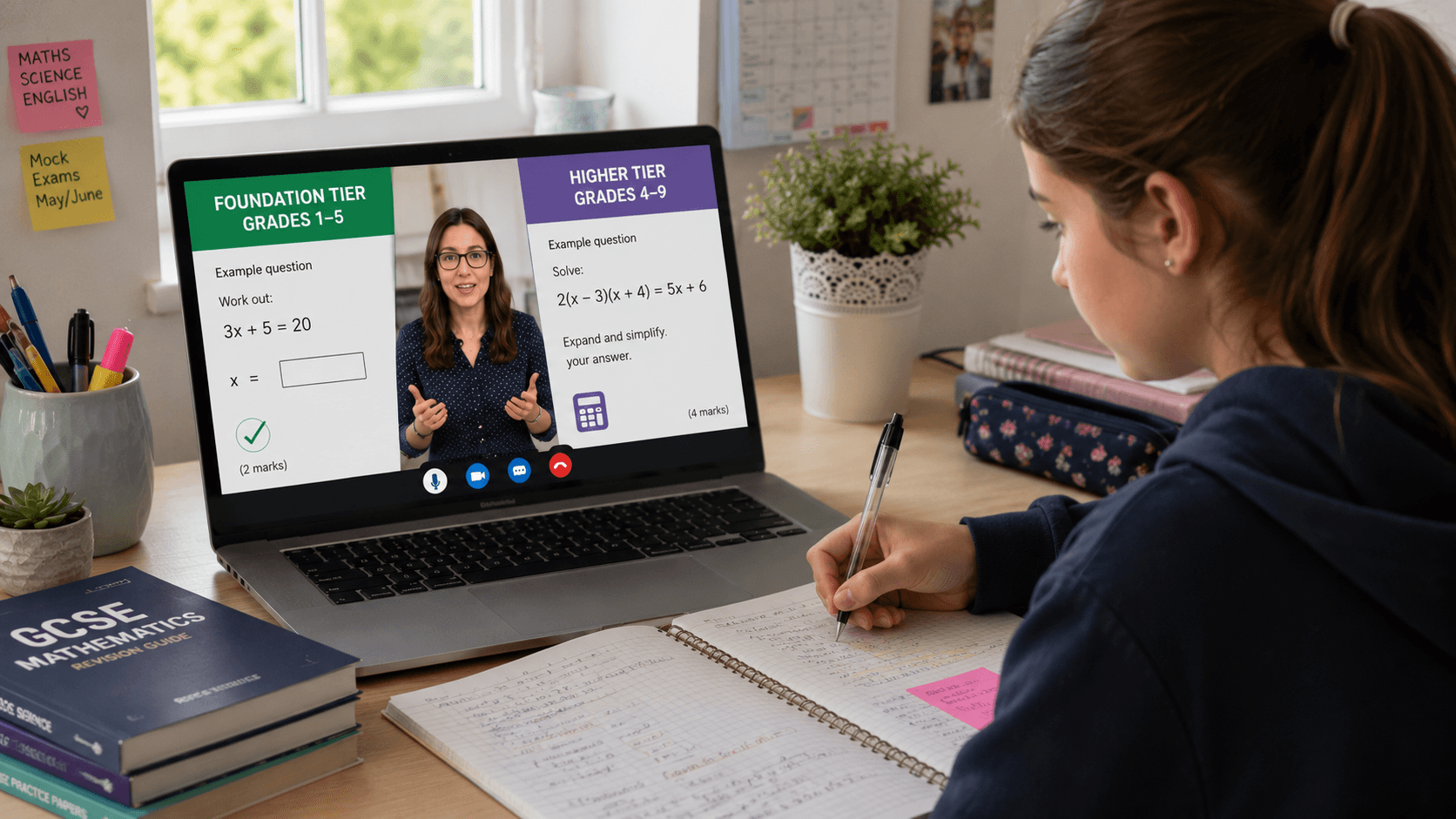
Foundation vs Higher Tier at GCSE: What’s the Risk of Getting It Wrong?
31/05/2025 / Private TutoringUpdated July 2026: This guide has been thoroughly reviewed, updated and expanded to reflect the latest curriculum requirements, examination guidance, educational best practice, and industry developments. Originally published in 2025, this revised edition includes updated information, improved advice, and additional resources to ensure it remains accurate and relevant.
If your child is preparing for GCSEs, you’ve probably heard teachers talk about Foundation Tier and Higher Tier examinations. For many parents, this can feel like one of the biggest decisions of Key Stage 4.
Should your child be entered for Foundation because it’s safer? Or should they attempt Higher to keep more opportunities open?
The answer isn’t always straightforward.
Choosing the right GCSE tier can influence:
- the grades your child is able to achieve
- their confidence during examinations
- progression to sixth form or college
- eligibility for certain A Level courses
- how they experience the final months of GCSE study.
Understandably, many parents worry about getting the decision wrong—particularly if their child is working close to the boundary between the two tiers.
The good news is that schools do not make these decisions lightly. Teachers use evidence gathered throughout Years 10 and 11 to decide which tier is most appropriate, aiming to give every pupil the best opportunity to achieve their potential.
This guide explains:
- what Foundation and Higher Tier exams are
- which GCSE subjects use tiers
- the grades available in each tier
- the risks and benefits of each option
- how schools decide which tier to enter
- whether pupils can change tiers
- how parents can support their child through the decision.
Foundation vs Higher Tier GCSE: At a Glance
| Foundation Tier | Higher Tier |
|---|---|
| Grades 1–5 available | Grades 4–9 available |
| More accessible questions | More challenging questions |
| No access to grades 6–9 | Access to the highest grades |
| Focus on core knowledge | Includes more advanced content |
| Lower academic risk | Higher reward, but greater challenge |
The important point is that neither tier is “better”. The best choice is the one that matches your child’s current attainment, confidence and future aspirations.
What Are Foundation and Higher Tier GCSE Exams?
The GCSE tiering system exists to ensure that pupils are assessed at an appropriate level.
Rather than expecting every student to sit exactly the same examination, certain GCSE subjects offer two different papers:
- Foundation Tier
- Higher Tier
Although both qualifications are equally recognised, each tier assesses a different range of knowledge and skills.
Foundation papers focus on essential concepts and accessible problem-solving, while Higher papers include more demanding questions designed to distinguish the highest-attaining pupils.
Importantly, pupils studying different tiers are still working towards the same GCSE qualification. The difference lies in the level of challenge and the range of grades available.
The aim is not to make one route easier or harder for its own sake, but to give every learner the greatest opportunity to demonstrate what they know.
Which GCSE Subjects Use Foundation and Higher Tiers?
Not every GCSE subject is tiered.
Most pupils encounter Foundation and Higher papers in:
- GCSE Mathematics
- GCSE Combined Science
- GCSE Modern Foreign Languages (depending on the specification)
- some GCSE Separate Sciences, depending on the awarding organisation.
Many popular GCSE subjects do not use tiers.
For example:
- English Language
- English Literature
- History
- Geography
- Religious Studies
- Business Studies
- Computer Science
are generally assessed using a single examination route for all pupils.
This sometimes surprises parents, who understandably assume every GCSE follows the same system.
What Is Foundation Tier?
Foundation Tier is designed for pupils who are developing secure understanding of the core GCSE curriculum and are working towards grades 1 to 5.
The questions are generally more accessible and focus on applying fundamental knowledge rather than tackling the most complex or abstract material.
Students entered for Foundation still complete a rigorous GCSE qualification. The papers are carefully designed to allow candidates to demonstrate what they know without requiring the additional content assessed only at Higher Tier.
Many pupils achieve excellent outcomes through Foundation Tier, particularly when their goal is to secure a strong pass while building confidence in a subject they have found challenging.
What Grades Can You Achieve on Foundation Tier?
Foundation Tier allows pupils to achieve:
| Grade Range |
|---|
| Grade 1 |
| Grade 2 |
| Grade 3 |
| Grade 4 |
| Grade 5 |
A grade 5 represents the highest possible result.
This means that even an outstanding performance on a Foundation paper cannot achieve grades 6, 7, 8 or 9.
For many students this is entirely appropriate. However, for pupils considering competitive sixth-form courses, this grade ceiling is an important factor.
What Is Higher Tier?
Higher Tier is designed for pupils who have demonstrated strong understanding of the GCSE curriculum and are ready to tackle more demanding questions.
The papers include:
- more advanced concepts
- longer multi-step problems
- unfamiliar scenarios
- greater mathematical reasoning or scientific application (depending on the subject)
- questions requiring deeper analysis.
Higher Tier provides access to the full GCSE grading scale, including the highest grades sought by many sixth forms and universities.
For pupils aiming for top grades, Higher Tier is usually the appropriate route.
What Grades Can You Achieve on Higher Tier?
Higher Tier provides access to:
| Grade Range |
|---|
| Grade 4 |
| Grade 5 |
| Grade 6 |
| Grade 7 |
| Grade 8 |
| Grade 9 |
Notice that grades 4 and 5 overlap between both tiers.
This overlap is deliberate.
It gives schools flexibility when deciding which tier best suits a pupil’s ability and allows students working around the national pass boundary to be entered for the examination most likely to reflect their strengths.
Why Do Grades Overlap?
Many parents ask why grades 4 and 5 appear in both Foundation and Higher Tier.
The reason is that pupils develop at different rates.
A student working securely at grade 5 might succeed through either route depending on:
- consistency in class
- mock examination performance
- confidence under pressure
- rate of recent progress
- teacher assessment.
This overlap allows schools to use their professional judgement rather than relying on a single test score.
For pupils working around the grade 5 boundary, deciding between Foundation and Higher often requires careful discussion between teachers, parents and the student themselves.
Foundation vs Higher Tier: The Key Differences
Although both routes lead to the same GCSE qualification, they differ in several important ways.
| Foundation Tier | Higher Tier |
|---|---|
| Grades 1–5 | Grades 4–9 |
| More accessible papers | Greater level of challenge |
| Focus on core curriculum | Includes advanced content |
| Lower academic risk | Greater opportunity for top grades |
| Suitable for pupils aiming for a secure pass | Suitable for pupils aiming for grades 6–9 |
Neither route should be viewed as a “better” qualification.
Instead, the goal is to choose the examination that allows a pupil to demonstrate their understanding with confidence while keeping appropriate future options open.
Excellent. Here’s Part 2, continuing the publication-ready article.
What Are the Risks of Choosing Foundation Tier?
Foundation Tier is the right choice for many pupils, but it’s important to understand its limitations before deciding that it is the safest option.
The most significant consideration is that Foundation Tier caps the highest possible grade at 5. Even if a pupil answers almost every question correctly, they cannot achieve grades 6, 7, 8 or 9 because those grades are only available through Higher Tier.
For students who hope to study subjects such as Mathematics, Physics, Chemistry or Economics at A Level, this can become an important factor. Many sixth forms and colleges ask applicants to achieve at least a grade 6 in the relevant GCSE before progressing to more demanding courses.
Choosing Foundation Tier therefore requires careful thought about both a pupil’s current attainment and their future ambitions.
The Main Risks of Foundation Tier
Your Child Cannot Achieve Grades 6–9
This is the biggest limitation.
If your child later performs exceptionally well, the highest available result remains a grade 5.
For pupils whose ability improves significantly during Year 11, this may feel frustrating if they were capable of achieving a higher grade.
Some A Level Courses May Not Be Accessible
Many sixth forms require:
- Grade 6 in GCSE Mathematics
- Grade 6 in GCSE Science
- occasionally higher grades for particularly competitive courses.
A grade 5 remains an excellent result, but it may not satisfy every course’s entry requirements.
Parents should check the requirements of any schools or colleges their child hopes to attend.
It Can Limit Future Flexibility
Some pupils develop rapidly during Year 11.
Improved confidence, better revision habits or additional academic support can lead to significant progress over several months.
If a pupil remains on Foundation Tier despite this improvement, they may be unable to access the grades their developing ability deserves.
What Are the Risks of Choosing Higher Tier?
Although Higher Tier provides access to the highest GCSE grades, it also presents greater challenges.
The questions are designed to stretch pupils’ understanding and often require them to combine several skills within a single problem.
For confident learners this is entirely appropriate.
However, for pupils working close to the Foundation/Higher boundary, the decision requires careful consideration.
Higher Tier Covers More Challenging Content
Higher papers include:
- more advanced concepts
- unfamiliar situations
- longer, multi-step questions
- greater mathematical reasoning
- more sophisticated scientific application.
This increased complexity can make examinations feel considerably more demanding.
Greater Pressure During the Examination
Some pupils perform well in class but become anxious under examination conditions.
If a pupil is already lacking confidence, sitting a paper that feels significantly beyond their comfort zone may affect their overall performance.
Confidence is an important factor when schools make tier recommendations.
Lower Safety Margin
Higher Tier offers access to grades 4–9.
However, pupils whose performance falls below the awarding threshold for a grade 4 may receive an unclassified (U) result rather than a GCSE grade.
This possibility is one reason schools carefully consider whether Higher Tier is appropriate for pupils working close to the boundary.
It does not mean Higher Tier should be avoided. Rather, it highlights why matching the tier to the pupil’s current level is so important.
Which Tier Is Best for Borderline Pupils?
Many parents ask the same question:
“My child is working around a grade 5. Which tier should they take?”
Unfortunately, there is no universal answer.
Borderline pupils are often the most difficult to place because they have the potential to succeed in either tier depending on how consistently they perform.
Teachers will usually consider several factors rather than relying on one assessment.
These include:
- mock examination results
- classwork over time
- homework quality
- recent progress
- confidence
- resilience during challenging tasks
- examination technique
- attendance.
A pupil who occasionally achieves a grade 6 but is inconsistent may receive a different recommendation from another pupil who consistently achieves a secure grade 5.
Professional judgement is therefore an essential part of the process.
Who Decides Which Tier Your Child Takes?
Although parents and pupils are involved in discussions, the final examination entry is normally made by the school.
This decision is based on a wide range of evidence gathered throughout Key Stage 4.
Teachers typically consider:
- classroom assessments
- end-of-topic tests
- homework
- mock examinations
- practical work (where appropriate)
- participation in lessons
- progress over time
- attitude towards learning.
Rather than focusing on a single score, teachers look for consistent patterns that indicate which examination is most likely to allow the pupil to succeed.
Their aim is not simply to maximise grades, but to ensure the examination is appropriately challenging while remaining achievable.
How Do Mock Exams Influence Tier Decisions?
Mock examinations play a particularly important role because they replicate many aspects of the final GCSE experience.
They help teachers evaluate:
- subject knowledge
- examination technique
- time management
- resilience under pressure
- ability to apply knowledge independently.
A strong mock result may indicate that a pupil is ready for Higher Tier.
Equally, a mock examination can reveal gaps in understanding that are less obvious during everyday classroom learning.
Parents should encourage their child to take mock examinations seriously, even though they do not contribute directly to the final GCSE grade.
The experience gained is valuable in its own right and often influences the support pupils receive during their final months of study.
Can Pupils Change Tiers?
Sometimes.
Tier entries are not always fixed at the beginning of Year 11.
If a pupil makes exceptional progress—or begins to struggle significantly—teachers may review the original decision.
However, changing tiers becomes increasingly difficult as the GCSE examinations approach.
Moving from Foundation to Higher
This is possible for some pupils, particularly when improvement occurs early in Year 11.
However, the pupil may need to learn additional Higher-only content alongside continuing their normal revision programme.
The earlier this decision is made, the more manageable the transition is likely to be.
Moving from Higher to Foundation
Schools occasionally recommend moving to Foundation when evidence suggests this will give the pupil a better opportunity to achieve a secure pass.
Although some students initially feel disappointed, this decision is often made to maximise their chances of obtaining a meaningful GCSE qualification.
The aim is always to match the examination to the pupil’s demonstrated level of understanding rather than to set an unrealistic challenge.
How Parents Can Support the Decision
Parents play an important role throughout the GCSE years.
Rather than focusing solely on grades, it is helpful to encourage honest conversations about how your child feels in the subject.
Consider questions such as:
- Do they generally feel confident?
- Do they enjoy solving challenging problems?
- Are they improving steadily?
- How do they cope with examination pressure?
- What are their plans after Year 11?
Listening carefully to your child’s own perspective can provide valuable insight alongside teacher recommendations.
If you remain unsure about the school’s decision, arrange a meeting with the subject teacher or Head of Department. They will usually be happy to explain the evidence behind the recommendation and discuss any recent improvements or concerns.
Most importantly, remember that Foundation and Higher Tier are both respected GCSE pathways. The objective is not to choose the “hardest” examination, but the one that gives your child the greatest opportunity to succeed.
Can Private Tuition Help with Foundation or Higher Tier GCSEs?
Whether a pupil is working towards Foundation or Higher Tier, the right support can make a significant difference to both confidence and attainment.
Some pupils need help securing the core knowledge required to achieve a strong pass at Foundation Tier. Others may be aiming to move from a grade 5 to a grade 6 or beyond, requiring the deeper understanding and problem-solving skills expected at Higher Tier.
One-to-one tuition provides an opportunity to focus on individual strengths and areas for development. A qualified teacher can identify misconceptions, adapt explanations to suit the learner and provide regular practice with exam-style questions at the appropriate level.
Importantly, tuition is not simply about improving grades. It can also help pupils:
- build confidence in challenging topics
- develop effective revision habits
- improve examination technique
- manage their time more effectively
- approach GCSE exams with greater confidence.
For pupils working close to the Foundation/Higher boundary, additional support may also give teachers clearer evidence of sustained progress when considering tier recommendations. However, no responsible tutor should promise that tuition will result in a change of tier or guarantee a particular GCSE grade. Progress depends on many factors, including the pupil’s engagement, attendance and consistent effort.
Frequently Asked Questions
Is Foundation Tier easier than Higher Tier?
Foundation Tier is designed to be more accessible, with questions focused on the core GCSE curriculum. Higher Tier includes more demanding content and provides access to grades 6–9. Neither route is “better”—the most appropriate tier depends on the pupil’s current attainment and future goals.
Can you get a grade 6 on Foundation Tier?
No. The highest grade available on Foundation Tier is grade 5.
Can you get a grade 5 on Higher Tier?
Yes. Grades 4 and 5 are available in both Foundation and Higher Tier examinations.
What happens if a pupil struggles on Higher Tier?
If a pupil’s performance falls below the awarding threshold for a grade 4, they may receive an unclassified (U) result. This is one reason schools consider tier entries carefully before examinations.
Who decides which GCSE tier a pupil takes?
The final examination entry is normally made by the school, based on evidence gathered throughout Key Stage 4. Teachers consider mock examinations, classroom performance, homework, progress over time and professional judgement before recommending the most appropriate tier.
Can a pupil move from Foundation to Higher Tier?
Sometimes. If a pupil demonstrates sustained improvement, schools may review the original tier decision. Moving tiers is generally easier earlier in Year 11 than immediately before the GCSE examinations.
Does Foundation Tier count as a full GCSE?
Yes. Foundation and Higher Tier both lead to the same GCSE qualification. The difference is the range of grades that can be achieved.
Helping Your Child Make the Right Choice
Choosing between Foundation and Higher Tier is one of the most important academic decisions many pupils make during GCSE study. While it can be tempting to focus solely on accessing the highest grades, the most successful outcomes usually come from selecting the tier that best reflects a pupil’s current understanding, confidence and long-term goals.
Foundation Tier offers an excellent opportunity for many students to secure a recognised GCSE qualification while developing confidence in subjects they may find challenging. Higher Tier provides access to the full range of GCSE grades and is often the right choice for pupils who are consistently demonstrating strong performance and are preparing for more advanced post-16 study.
Rather than viewing one route as better than the other, parents should think about which option gives their child the greatest opportunity to demonstrate what they genuinely know and can do.
Regular communication with teachers, careful preparation for mock examinations and consistent revision throughout Year 11 all contribute to making the most informed decision possible.
Need Support with GCSE Foundation or Higher Tier?
If your child is unsure whether Foundation or Higher Tier is the right option, or would benefit from additional support in GCSE Mathematics, Science or another tiered subject, personalised tuition can help them build confidence and strengthen their understanding.
At Principal Tutors, we provide one-to-one online tuition with qualified and experienced teachers who understand the current GCSE curriculum and the differing demands of Foundation and Higher Tier examinations. Our managed tutor-matching service carefully considers each learner’s subject, level, goals and learning needs before introducing a suitable tutor, helping families find the right educational support rather than simply choosing from a directory of profiles. Tutors provide personalised lessons, written feedback after each session and ongoing support throughout the learning journey.
Whether your child needs help securing a confident pass at Foundation Tier or is aiming for the higher grades available through Higher Tier, our tutors can provide tailored guidance, exam practice and subject-specific support designed to help them make steady, meaningful progress.
To find out more, explore our GCSE tuition, browse our qualified online Maths tutors or Science tutors, or request a tutor to discuss your child’s needs with one of our Education Consultants.
This article has been reviewed by the education specialists at Principal Tutors, a multi-award-winning UK tuition company. Our tutors are UK-qualified teachers with extensive classroom experience, enhanced DBS checks, and expertise in supporting students across the UK curriculum.
Originally published: 2025
Last updated: July 2026
Mike
We are so happy with our 11+ tutor, she is always very professional and approachable, and she is helping my son to gain in confidence for his grammar school entrance exams next term.
Sheila
Very happy with the Tutor who is working with my daughter for the 11+. He always replies to emails promptly, engages my daughter during the online lesson, and she's enjoying the work. Thank you.
Nicole
We were recommended a tutor for our needs very quickly and were able to start immediately. My daughter is getting tutoring for her 11+ exam and according to her, the tutor is amazing. There is a long way until the exam but she managed to bust my daughter's confidence in Maths. Thank you!
Danielle
Thank you for recommending such an amazing physics tutor for my son. We are now confident he will achieve the graded he needs to get into the uni of his choice, which is all down to the support we received from Principal Tutors and our wonderful tutor.
