

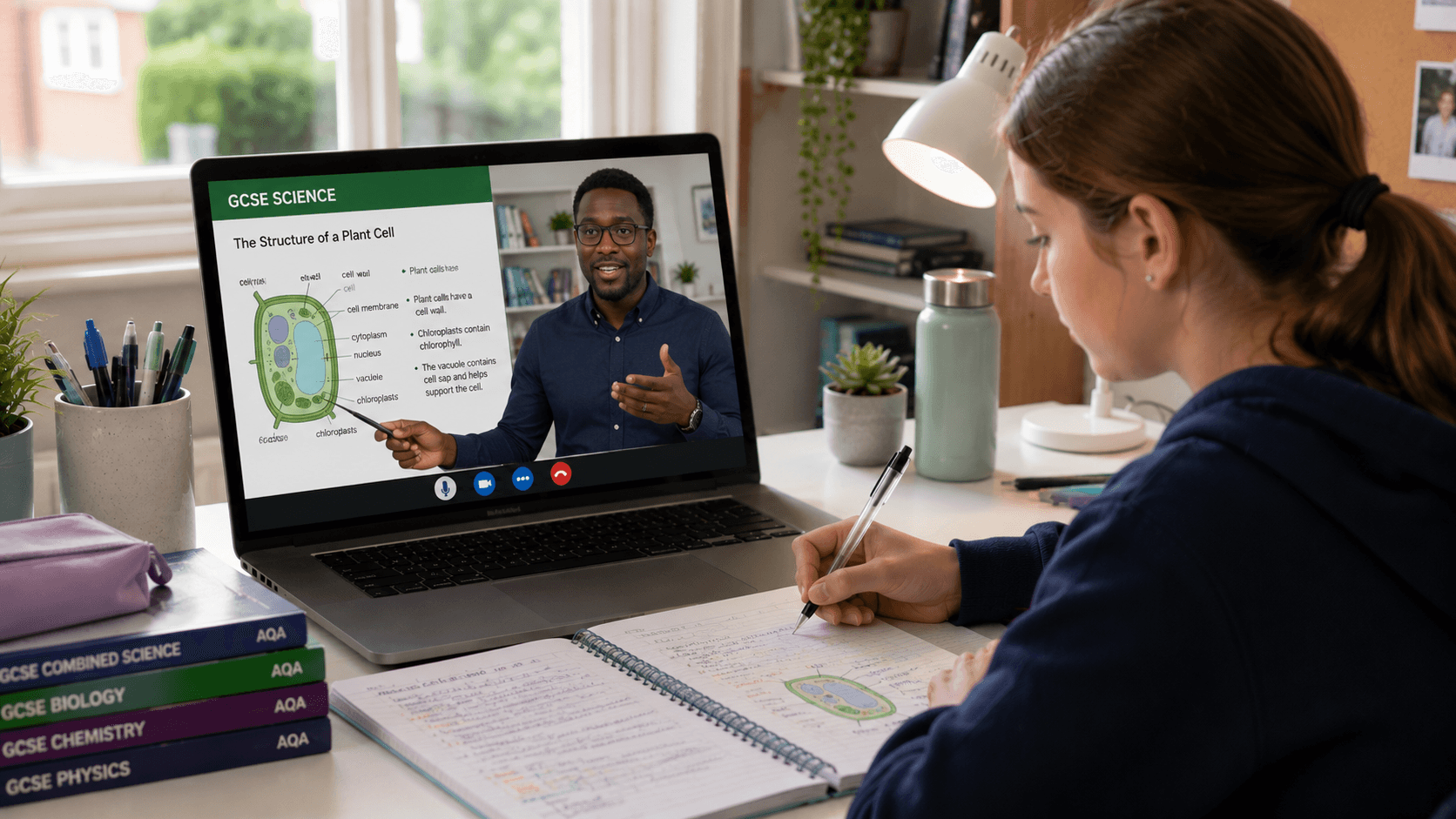
GCSE Science Syllabus – A Clear & Simple Guide (2026 Edition)
03/04/2025 / Science TuitionUpdated July 2026: This guide has been thoroughly reviewed, updated and expanded to reflect the latest curriculum requirements, examination guidance, educational best practice, and industry developments. Originally published in 2025, this revised edition includes updated information, improved advice, and additional resources to ensure it remains accurate and relevant.
Introduction to the GCSE Science Syllabus
GCSE Science is a key part of your child’s secondary education, helping them develop a deeper understanding of the world through Biology, Chemistry and Physics. Whether your child plans to pursue a career in medicine, engineering or another STEM field, or simply wants to achieve the best grades possible, GCSE Science provides valuable knowledge and transferable skills that will support them throughout their education and beyond.
This guide is designed for parents and carers who want to understand how GCSE Science works, what their child will study, how the exams are structured, and how they can provide effective support throughout Years 10 and 11.
In England, schools follow GCSE Science specifications produced by AQA, Pearson Edexcel and OCR, while WJEC qualifications are used in Wales. Current specifications remain in place for students sitting examinations in 2026. Required practical activities continue to be assessed through written examination questions rather than separate coursework, and any future curriculum reforms proposed by the Department for Education (DfE) and Ofqual are not expected to affect students taking GCSEs in 2026.
Understanding the structure and expectations of GCSE Science is one of the best ways parents can help their child feel confident, stay motivated and achieve their potential.
GCSE Science at a Glance
| Feature | Details |
| Subjects | Biology, Chemistry and Physics |
| Study Routes | Combined Science or Triple Science |
| Assessment | Written examinations |
| Required Practicals | Assessed through written exam questions |
| Grading | 9–1 |
| Typical Student Age | 14–16 |
| Number of Papers | Usually six written papers |
| Exam Length | Combined Science: approximately 1 hour 10 minutes per paperTriple Science: approximately 1 hour 45 minutes per paper |
| Qualification Awarded | Combined Science: 2 GCSEsTriple Science: 3 GCSEs |
GCSE Science Exam Boards Explained
In England, GCSE Science is offered by three main exam boards: AQA, Pearson Edexcel, and OCR. In Wales, schools generally follow WJEC specifications, while Scotland has a different qualifications system based on National Qualifications rather than GCSEs.
Although each exam board has its own style of assessment and question wording, the content students study is largely the same because all specifications follow the national curriculum.
Regardless of the exam board, students will:
- study Biology, Chemistry and Physics
- complete required practical activities that are assessed through written examinations
- develop scientific enquiry, data analysis and mathematical skills
- be graded using the 9–1 GCSE scale
- sit either Foundation Tier or Higher Tier papers, depending on their school and ability level.
The main differences between exam boards lie in the structure of the examination papers, the style of questions and the emphasis placed on certain topics. While these variations may influence how students prepare for their exams, they do not significantly change what they are expected to learn.
For parents, the most important thing is to know which exam board your child’s school follows. This allows you to access the correct revision guides, past papers and online resources, ensuring your child practises using questions that match the format they will encounter in their exams.
Excellent. Here’s the next section, professionally edited to remove repetition, improve readability and keep the tone parent-friendly.
Combined Science vs Triple Science: What’s the Difference?
One of the first decisions your child may face in Key Stage 4 is whether to study Combined Science or Triple Science. While both routes cover Biology, Chemistry and Physics, they differ in the depth of content studied, the number of GCSEs awarded and the workload involved.
Choosing the right option depends on your child’s interests, academic strengths and future plans.
Combined Science (Double Award)
Combined Science covers all three sciences but in less depth than Triple Science. At the end of the course, students receive two GCSEs, with grades reflecting their overall performance across Biology, Chemistry and Physics.
This route is well suited to students who:
- want a balanced GCSE workload
- enjoy science but do not plan to specialise in it after GCSE
- wish to keep their future options open while studying a broader curriculum.
Triple Science (Separate Sciences)
Triple Science allows students to study Biology, Chemistry and Physics as three separate GCSE subjects. The course includes additional content and explores topics in greater depth than Combined Science, with students receiving three individual GCSEs.
It is often the preferred option for students who:
- have a strong interest in science
- consistently achieve well in the subject
- are considering A Levels in Biology, Chemistry or Physics
- hope to pursue STEM-related degrees or careers, such as medicine, engineering or environmental science.
Which Option Is Best?
Neither route is “better”—the right choice depends on your child’s goals and learning style.
Combined Science may be the better option if your child:
- wants a more balanced workload across all GCSE subjects
- is undecided about studying science after GCSE
- prefers a broader understanding rather than studying topics in greater depth.
Triple Science may be the better option if your child:
- is highly motivated by science
- enjoys challenging academic work
- is aiming for science-based A Levels or a STEM career.
Although many sixth forms recommend Triple Science for students intending to study science at A Level, it is not always a requirement. If you’re unsure which route is most suitable, speak to your child’s science teacher or Head of Year, who can advise based on their progress, strengths and aspirations.
Perfect. This next section can be made much more concise because you’ve already explained the exam boards and the difference between Combined and Triple Science. There’s no need to repeat those points.
What Will My Child Study in GCSE Science?
GCSE Science introduces students to the fundamental principles of Biology, Chemistry and Physics, helping them understand everything from living organisms to chemical reactions and the physical laws that govern the world around us. While the exact specification varies slightly between exam boards, the core content is broadly the same.
Biology – Understanding Living Organisms
Biology explores how living things function, interact and evolve. Students will study topics including:
- Cell biology
- Organisation of plants and animals
- Infection and the immune system
- Bioenergetics, including respiration and photosynthesis
- Homeostasis and the body’s control systems
- Inheritance, variation and evolution
- Ecology and environmental sustainability
Chemistry – Understanding Materials and Reactions
Chemistry helps students understand the properties of substances, how reactions occur and the role chemistry plays in everyday life. Topics include:
- Atomic structure and the periodic table
- Bonding, structure and the properties of matter
- Quantitative chemistry and chemical calculations
- Chemical and energy changes
- Organic chemistry
- Chemical analysis
- Earth’s atmosphere and the sustainable use of resources
Physics – Understanding Energy and the Universe
Physics explains how energy, forces and matter shape the world around us. Students will study:
- Energy transfers and efficiency
- Electricity and electrical circuits
- The particle model of matter
- Atomic structure and radioactivity
- Forces, motion and pressure
- Waves, including light and sound
- Magnetism and electromagnetism
- Space Physics (Triple Science only)
Together, these topics develop scientific knowledge alongside analytical, mathematical and problem-solving skills that prepare students for further study, future careers and everyday decision-making.
Hands-On Science: Required Practicals
Practical work is an essential part of GCSE Science. Although students are not assessed through separate practical coursework, they are expected to understand the methods, results and scientific principles behind a series of required practical activities, which are examined through written exam questions.
These practicals help students develop observation, investigation and data analysis skills while reinforcing the scientific concepts they learn in class.
Biology Practicals
Students typically investigate:
- Using a microscope to observe cells
- Osmosis using potato samples
- Enzyme activity under different temperatures and pH levels
Chemistry Practicals
Common practical activities include:
- Acid-base titrations
- Electrolysis
- Investigating rates of reaction
Physics Practicals
Students may carry out investigations involving:
- Electrical resistance
- Specific heat capacity
- Lenses and the behaviour of light
While memorising every practical isn’t necessary, students should understand the purpose of each investigation, the variables involved, the expected results and how conclusions are drawn from experimental data.
Excellent—these last sections are where we can make the biggest improvements. The original begins to repeat ideas about practicals, revision and support. Here’s how I’d rewrite them.
Scientific Skills Your Child Will Develop
GCSE Science is about more than learning facts. Throughout the course, students develop a range of practical, mathematical and analytical skills that are valuable across many subjects and future careers.
Applying Maths in Science
Mathematical skills form an important part of GCSE Science. Students will learn to:
- convert between units
- use equations and scientific formulae
- calculate quantities such as speed, energy and rates of reaction
- interpret graphs, charts and tables
- analyse numerical data accurately.
Analysing Practical Investigations
Students are expected to understand how scientific investigations are planned, carried out and evaluated. They will learn to:
- identify independent, dependent and control variables
- recognise patterns and trends in data
- draw evidence-based conclusions
- evaluate the reliability of experimental results
- identify anomalies and suggest improvements.
Scientific Communication
Clear communication is an essential scientific skill. Students will practise:
- using accurate scientific terminology
- interpreting exam questions carefully
- writing clear, logical explanations
- presenting evidence to justify conclusions.
Together, these skills prepare students not only for GCSE examinations but also for further education and real-world problem solving.
Common Challenges in GCSE Science
GCSE Science covers a broad range of topics, so it’s normal for students to find some areas more challenging than others. Recognising these difficulties early allows parents to provide effective support before small gaps become bigger problems.
Understanding Abstract Concepts
Some topics—such as energy transfer, chemical bonding and radioactivity—can be difficult because students cannot easily observe them in everyday life.
You can help by encouraging your child to explain concepts in their own words and by using diagrams, videos or animations to reinforce classroom learning.
Applying Knowledge to Exam Questions
Many students understand the science but struggle to apply their knowledge in unfamiliar exam scenarios.
Regular practice using past papers and mark schemes helps students become familiar with command words, improve exam technique and develop confidence when answering longer questions.
Managing the Workload
Students taking Triple Science cover more content than those studying Combined Science, making effective organisation particularly important.
Encourage your child to:
- create a realistic revision timetable
- review topics regularly rather than cramming
- break revision into manageable sessions
- take regular breaks to maintain focus
- ask for help when they don’t understand a topic.
Consistent revision over time is usually far more effective than intensive revision immediately before exams.
Key Takeaways
GCSE Science gives students a strong foundation in Biology, Chemistry and Physics while developing valuable analytical, mathematical and practical skills.
As a parent, you can make a significant difference by:
- understanding the course structure
- encouraging regular revision
- helping your child practise exam technique
- supporting effective organisation
- seeking additional support if needed.
Small, consistent steps throughout Years 10 and 11 often have the greatest impact on confidence and exam performance.
Helping Your Child Succeed in GCSE Science with Principal Tutors
The Future of Tutoring report reflects what many parents and teachers already recognise: high-quality tutoring can improve both academic performance and confidence.
At Principal Tutors, we provide one-to-one GCSE Science tuition delivered by fully qualified teachers with extensive experience of the UK curriculum. Every student is carefully matched with a tutor who suits their learning style, personality and academic goals.
Whether your child needs help strengthening subject knowledge, improving exam technique or aiming for the highest grades, personalised support can help them build confidence and reach their potential.
Ready to support your child’s GCSE Science journey?
Call 0800 772 0974 or complete our simple online tutor request form to find the right tutor for your child.
This article has been reviewed by the education specialists at Principal Tutors, a multi-award-winning UK tuition company. Our tutors are UK-qualified teachers with extensive classroom experience, enhanced DBS checks, and expertise in supporting students across the UK curriculum.
Originally published: April 2023
Last updated: July 2026
Mike
We are so happy with our 11+ tutor, she is always very professional and approachable, and she is helping my son to gain in confidence for his grammar school entrance exams next term.
Sheila
Very happy with the Tutor who is working with my daughter for the 11+. He always replies to emails promptly, engages my daughter during the online lesson, and she's enjoying the work. Thank you.
Nicole
We were recommended a tutor for our needs very quickly and were able to start immediately. My daughter is getting tutoring for her 11+ exam and according to her, the tutor is amazing. There is a long way until the exam but she managed to bust my daughter's confidence in Maths. Thank you!
Danielle
Thank you for recommending such an amazing physics tutor for my son. We are now confident he will achieve the graded he needs to get into the uni of his choice, which is all down to the support we received from Principal Tutors and our wonderful tutor.
